
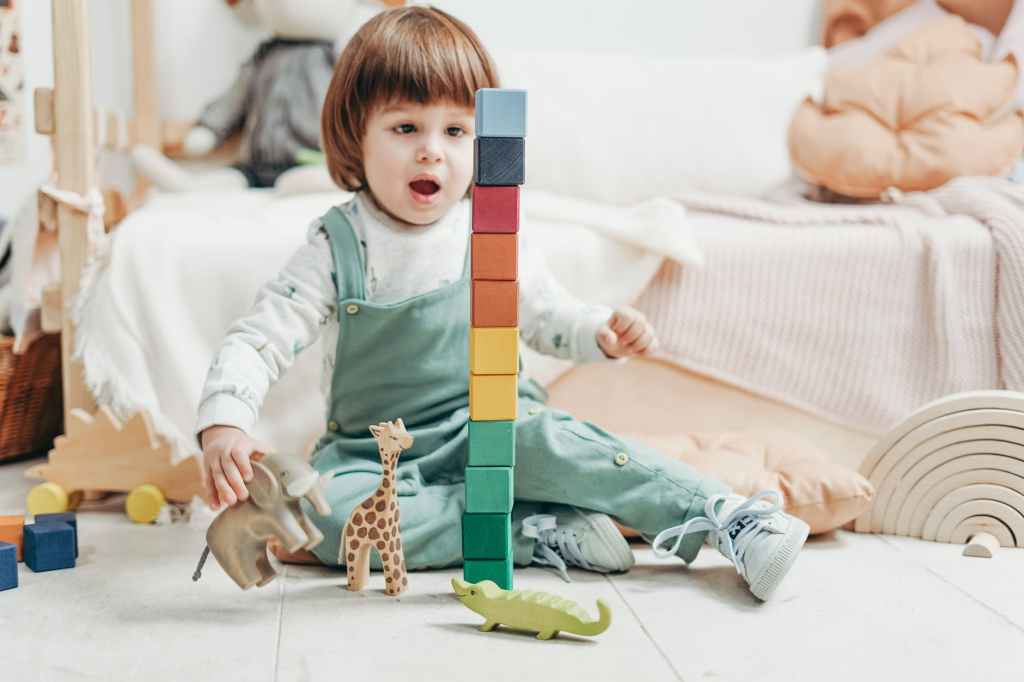
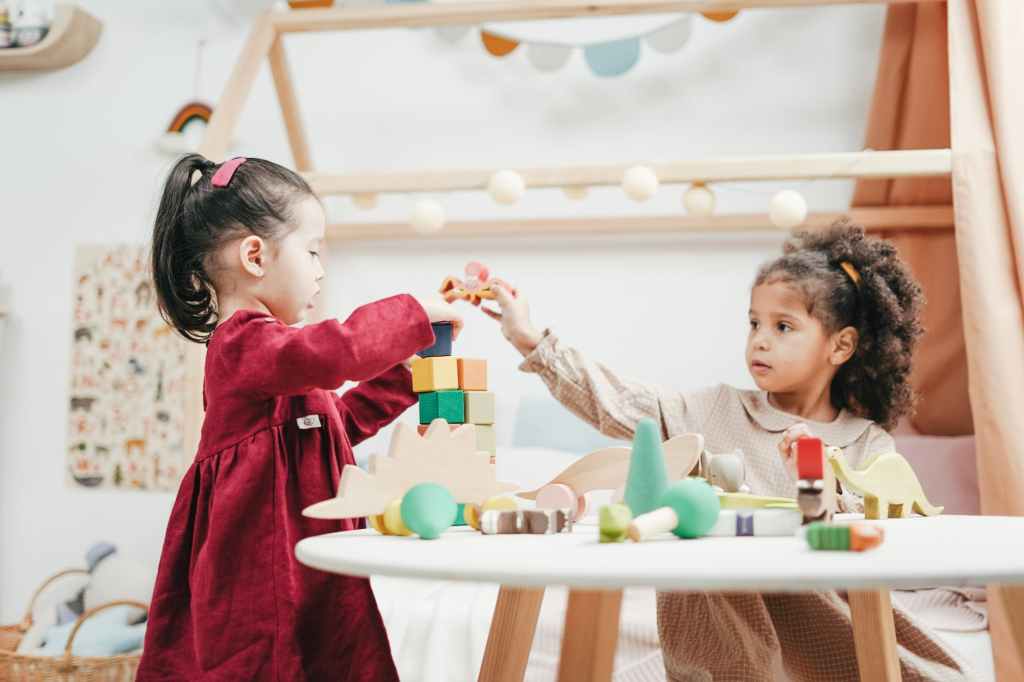
A child absorbed in play is truly a wonderful thing. To see them transported into their own imaginative world and become oblivious to the world will never cease to amaze me. There are no rules, they can change character as they please and a ball which was rolling along the ground a moment ago, has now become an egg to eat for dinner! This kind of undirected free play is a vital component of the Waldorf curriculum in the early years. Play is the work of childhood and Steiner believed that the first 7 years of a child’s life should largely be devoted to free play. He wrote, “This kind of free play is what we need to study!” Steiner believed that the intellect of the child should not be stimulated until the changing of the teeth, around the 7th year. Instead the child should engage in deep and meaningful play while living life alongside their parent or caretaker.
Certain themes evolve in children’s play and they are often universal; playing families, digging, building, teaching and caring for others. I have just started to see these themes emerge in my two-year old’s play. He has recently started using his cars to play ‘going to Yia Yia’s house.’ Just the other day he played ‘shopping’ by filling a bag with random household items and saying that he was buying them.
Independent play can also assist parents by giving us some precious, uninterrupted time. So, how can we get this play to happen more often? Here are 10 ideas to get you started:
1. Meet their needs first
Children can only play independently if all their needs have been met. Obviously it’s not possible to meet their needs all of the time, but if we can try to do this first, we have a better chance of our child playing independently. So before encouraging your child to play by themselves, ask yourself; are they well rested? Have they eaten recently? Do they need to go to the toilet/have their nappy changed? Do they feel secure and safe in their relationship with you?
2. Side by side play
Start by playing with your child. Get down on their level and engage in their game if they want you to. After a few minutes let them know that you are need to do something and leave for a short while. Just enough time to put the kettle on or a load of washing. Then return to your child and continue playing with them. Over time you should be able to leave them for longer periods of time, but if you say you are coming back soon, make sure that you return in a reasonable amount of time. If your child won’t let you leave even for a minute, you might need to spend longer playing with them. They may have unmet needs or just need to be close to you on that particular day.
3. Set up an activity
Setting up an activity can be one way to engage your toddler’s interest. One of our favourites is a tray of dried beans with a selection of small diggers and tip trucks. Another simple one is a bucket of water with some measuring cups.
4. Set up toys during nap time/the night before
There’s something special about waking up to an invitingly displayed set of toys or a simple activity that the child knows has been set up for them. It can be as simple as displaying the child’s toys in a different manner or more involved such as setting up crayons and paper for drawing. If a child discovers an activity of their own accord they are much more likely to sit down and engage with the activity.

5. Rotate your child’s toys
Try having just a small number of toys available for your child to play with and rotating them regularly. Studies have shown that children will engage in a deeper level of play and play for longer periods of time when they have fewer toys. Having a varied selection of 8 – 10 groups of toys on offer at one time and rotating them when you feel is necessary can help your child play independently for longer periods of time.
6. Bring your work to their play
If you child is playing, but wants to have you close, you could try bringing your work to their play. This doesn’t work for all tasks, but if you are folding clothes you could bring the clothes basket to their play area and observe them as you fold. Sometimes our children just want to feel our presence.
7. Outside play
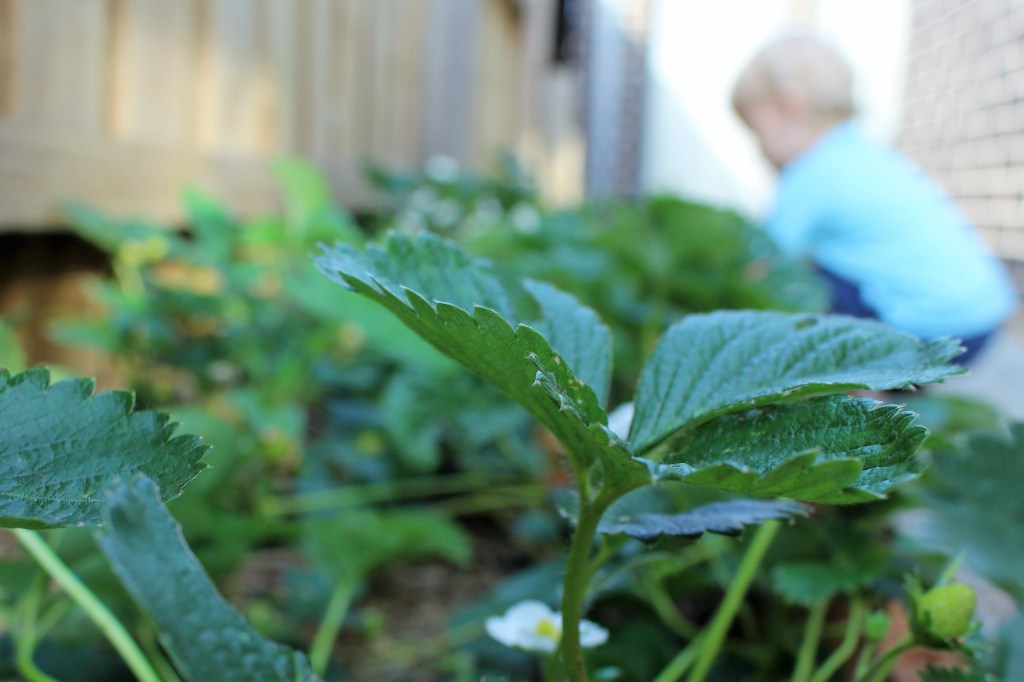
If you have a backyard, taking your child outside can be an easy way to encourage them to play independently. Try to create a safe place where they can explore and need minimal supervision. A sandpit with some buckets and spades can be an excellent addition to any backyard. Children love to help with the gardening so if you have a veggie or flower garden they can learn how to water, pull out weeds and pick produce.
8. Change your toy set up
Old toys displayed in a new way can help a child to rediscover an old toy or use it in a new way. If toys are invitingly displayed children will be more likely to engage with them. Try using low shelves so that toys are displayed at child’s height, open baskets and have toys grouped together ie all the cars and trucks in one basket, play cloths in another and animal figures in another basket.
9. Include a variety of toys
Offering a variety of resources does not mean having a lot of toys. Have a look at your collection and see if there are a variety of play options, including some open-ended and some close-ended (read more about types of toys here). We have found that 8 – 10 play options work well for our two-year-old. You might like to include something to build and create with, such as building blocks, animal figures or small wooden people, some cars and/trucks, wooden houses, dolls, a doll’s house, a wooden rainbow or other stacking option and a train track set or doll’s house. The local op-shop can be a great place to find second-hand toys, as can Facebook Marketplace or hand-me-downs from friends and family. Although it is nice to have a few new toys, your child will not be able to tell whether the toy is brand new or second hand – it is new to them and that’s all that matters.
10. Small steps
Be patient with yourself and your toddler and remember that independent play may not happen for extended periods of time until your little one is 3 – 4 years old. Start when they are young, but only except short bursts of attention until they are older. Over time they will gradually be able to spend longer periods of time involved in play and they will start to happily engage in independent play without any prompting from you.
What have you found effective to help your toddler play independently?
Further reading:
Steiner, Rudolf (1986): Soul Economy and Waldorf Education, GA 303, Anthroposophic Press.
Stone, Lael. Rose, Marion. Aware Parenting Podcast.
Carly Dauch. Michelle Imwalle. Brooke Ocasio. Alexia E. Metz. The influence of the number of toys in the environment on toddlers’ play. Infant Behavior and Development. Volume 50, February 2018, Pages 78-87.


 The Steiner Connection