

This post is part of a series on how to incorporate 5 aspects of the Steiner kindergarten program into your Waldorf home. Today we will be focusing on the element of creating art through drawing. For an overview of all 5 elements, click here.
Drawing in the Waldorf preschool is an unguided process. There are no black lines to ‘colour-in’, dots to join or prepared artworks to copy. A set of beeswax crayons are placed on the table and a piece of paper is put in front of each child. Often the teacher sings a song as the drawing process begins or a story is told. The children are free to draw what they like and no guidance is given unless the crayons are being used inappropriately.
I have been drawing in this way with my two-year-old for a few months now. Some days he loves to draw on the paper (as well as the table, walls and floor…) Other days he is more interested in stacking the crayons or pretending that they are cars. Drawing is a part of our week which I really enjoy and it is lovely to explore this creative outlet.
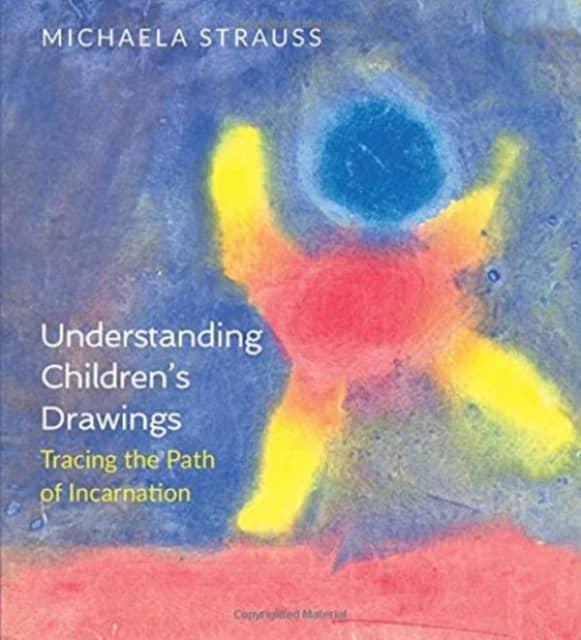
Drawing in an unguided manner allows the child to express their inner will. Steiner explained that drawing is one of the ways in which the child communicates with the outside world and that it is our job as the teacher (or parent) to read the child’s drawings. A lovely way to gain insight into your child’s development is to keep the drawings in the order that they were created (and date the back of each one) then look through them every few months. For more details on analysing children’s drawings, see Michaela Strauss’ book – Understanding Children’s Drawings.
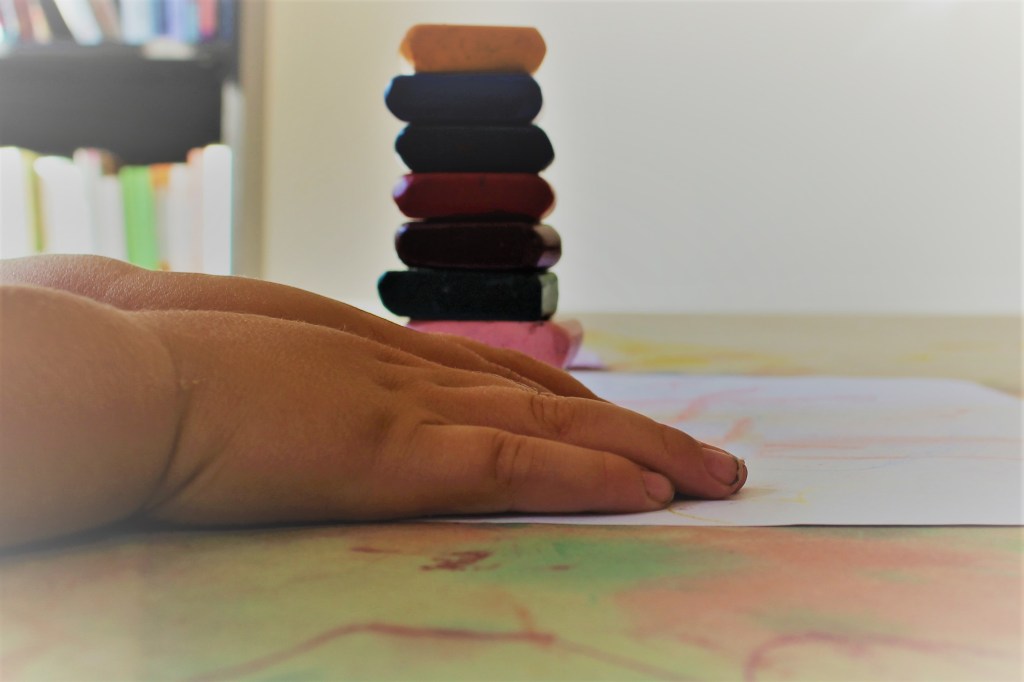
Drawing in the early years develops the senses of sight and movement. It engages the child’s fine motor skills and works on the developmental skill of crossing the midline. It is an important pre-literacy activity and prepares the muscles of the hand for the pencil grip.
By using quality materials such as Stockmar beeswax crayons children are also activating their sense of touch and smell. The crayons feel smooth and warm in the hand. They have a faint smell of beeswax.
It can be a new experience to use these crayons if you are used to fine tipped pencils. The block crayons especially may seem strange to use at first. They make it difficult to create definition or outlines, but produce lovely shading. I suggest that you try them alongside your child and see what the experience brings for you.
Materials and Colour Choice
Waldorf kindergartens traditionally use a beeswax crayon such as Stockmar. These crayons come in two different forms – block or stick. There is much debate over whether children should use the block or stick varieties or a mixture of both. The finer point on the stick crayons can produce more detail and encourage correct pencil grip. The block crayons allow for more shading and encourage expressiveness. The block crayons also fit nicely into small hands. Currently we use block crayons in our home, but I am considering adding in stick crayons when my son is a little older.
Another cause for debate is which colours to offer. Some Steiner preschools only offer the rainbow spectrum – red, yellow, blue, orange, green, and violet. Some include black, brown and pink skin tones. Some Steiner kindergartens are entirely against offering black or brown. This topic is a complex issue which also raises the discussion of cultural diversity.
Van James (artist, Waldorf educator and author) states that children should be offered the full spectrum of rainbow colours as well as black and brown. He goes so far as to say:
‘…the complete and permanent removal of the colour black from the child’s range of available colours would be a real Waldorf misunderstanding.’
In his reasoning for including the colour black Van James discusses Steiner’s lectures on the matter. Steiner stated, ‘Black represents the spiritual image of the lifeless.’ However, Steiner also explained that in black ‘the spirit flourishes’. He believed that young children are not affected by black in the same way as adults because their spirit can fill the void.
The choice of which colour palette to offer your child is an important one to consider. There are many different options and no definite answer. You may choose to exclude black until the 7th year, offer it sporadically, or always have it available. At the moment I offer my son the colours from the rainbow spectrum. However, reading Van James’ work has encouraged me to reflect on my decision and I may change our colour palette in the future.

The Process
Here is our complete Waldorf drawing process from start to finish with our two-year-old. You may like to make certain adjustments depending on the age of your child/children, but this is what works for us at the moment.
If you would like a downloadable version of this drawing guide click here.
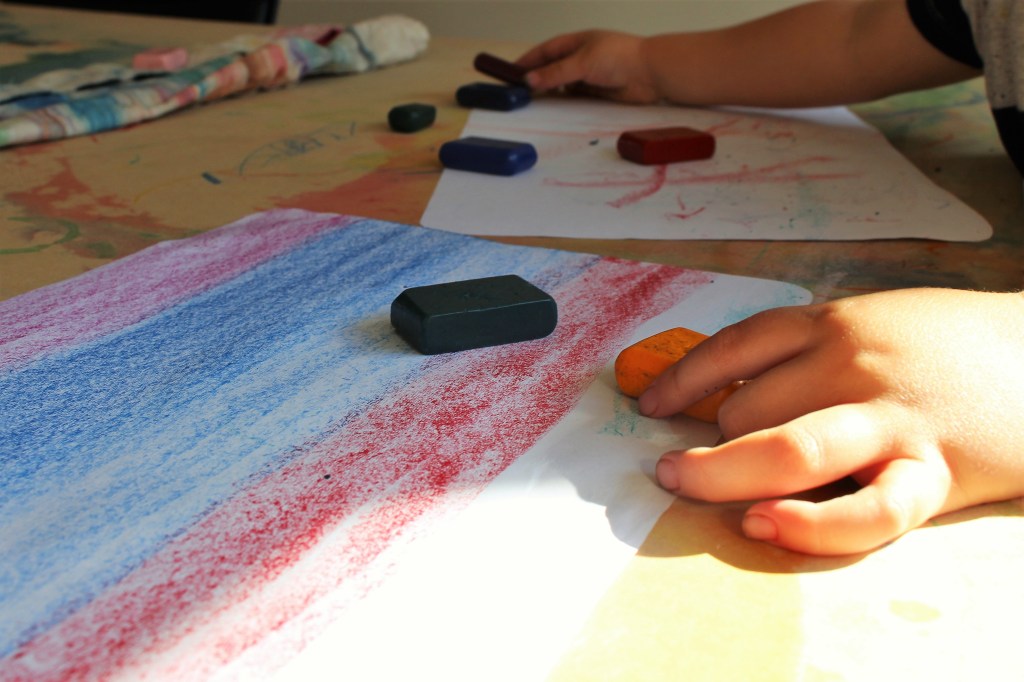
Materials
- A small selection of Stockmar beeswax crayons – we include the rainbow spectrum; red, yellow, blue, orange, green and violet. You may also like to include black or brown.
- A large wooden board (a drawing board) or newspaper for protecting your table
- Plain A4 or A3 paper
Routine
Drawing in our home takes place on a weekly basis. I set up the drawing board, crayons and paper after my son’s nap. When he realises what I am doing he normally rushes over to help.
As I am setting up I sing this song:

This song is set in mood of the fifth, a style of music based on recommendations from Steiner. It is centred around the note A often referred to as the sun tone and it is thought to be most appropriate for children aged 0-7.
When everything is set up we sit down and start to draw. I try not to give any instructions other than an occasional reminder of, ‘crayons draw on the paper.’ He is free to draw what he likes (or to not draw at all). This indirect approach is most suitable for young children. As your child grows you may like to include a short story before drawing, but it is not necessary with younger children. By simply drawing alongside them you are giving instruction enough.
Above all remember that drawing is a time for the child to express their inner will. The parent provides the materials for the child and then holds space for the child to explore. At this age, praising the child’s effort or concentration is more beneficial than praising the end result.
As we draw I may continue to sing our drawing song or we may draw in silence depending on the day.
When we are nearly done I start to sing our pack up song and my son knows that it is time to finish up. Normally by this stage he has lost interest, but if he needs help I will say ‘last crayons’ and give him the opportunity to choose one more colour. We finish with our final colours and pack up.
Uses for drawings
If you bring drawing into your rhythm on a weekly basis you will soon have more drawings than you know what to do with. Here are a few uses for them:
- Gift wrapping paper
- Birthday Cards
- Easter Baskets
- Midwinter Lanterns
- Origami activities
I hope you enjoy your time spent drawing as much as we do!
Further reading:
The Renewal of Education – Rudolf Steiner
Understanding Children’s Drawings – Michaela Strauss


 The Steiner Connection