
Have you heard of the 12 senses?
Steiner often spoke of the 12 senses in relation to healthy human development. Having a better understanding of these senses can help parents to support healthy childhood development.
Read on to discover more…

What are the 12 senses?
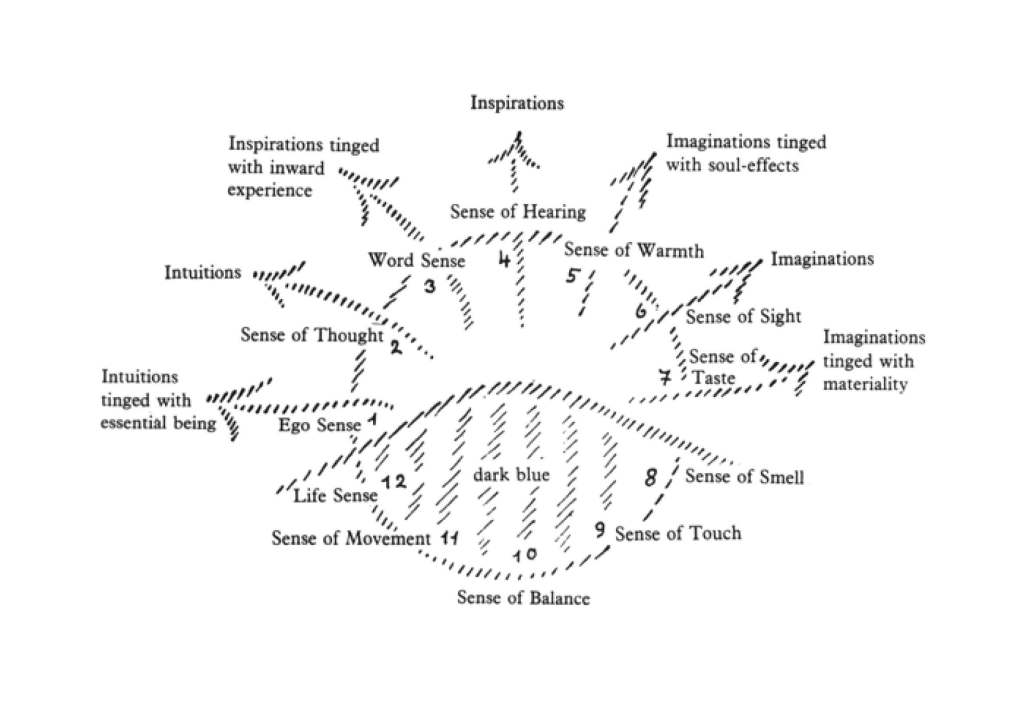
According to anthroposophy, the 12 human senses are the way in which the soul experiences the external world. Humans don’t relate to the world only through the 5 senses which are normally considered; rather Steiner held a 12 fold view of the senses. They are: Touch, Life, Self-Movement, Balance, Smell, Taste, Sight, Temperature/Warmth, Hearing, Language, Thought and Ego or the sense of the ‘I’.
Steiner spoke on the idea of the 12 fold picture. This image gives us the 12 human senses, the 12 months and the 12 zodiac signs. Over the course of the year the sun travels through each of the zodiacs and in a similar way our inner life moves through the 12 senses.
‘Everything we have in us, even everything we experience in our soul, is related to the outer world through our twelve senses.’
Rudolf Steiner
During the first phase of life, between the age of 0 to 7 years, Steiner indicated that there are 4 senses which are primarily being developed; Touch, Life, Self-Movement and Balance. In the second life phase, from 7 to 14 years, the senses of Smell, Taste, Sight and Temperature/Warmth are under development. Finally, between the ages of 14 and 21, the last four senses are being developed: Hearing, Language, Thought and Ego.
This is not to say that all senses can’t be nourished throughout all life phases. The groundwork is laid in the early years to nourish all senses, but the sense will not be fully developed until the appropriate life phase is complete.
What are the 12 Human Senses?
Let’s look more deeply into each of the 12 senses and their relationship to the human body:
Touch
The sense of touch relates to what our body comes into contact with and involves the feeling of brushing up against a boundary. Different textures and materials all activate the sense of touch. The feeling of cool sand running between your fingers. The smooth feeling of a small, hard pebble.

Life Sense
The life sense arises when we are ill or injured. It creates pain which lets us know that there is something wrong. Steiner spoke of a ‘Spirit Man’ who watches over us and alerts us via pain when something is not right. This sense is closely linked to attention and self-regulation.
Self-Movement
The sense of movement is the awareness of our muscles and joints when we move through space. This sense also relates to our life movement from birth to death and our biographical path.
Balance
Balance relates to how we stand within a space. This sense is not developed at birth, but gradually develops over time. If you have seen a toddler learning to walk then you have witnessed this sense in action. It is strongly linked to the sense of movement and is intricately linked to the workings of the inner ear.

Smell
Often, we have no choice as to whether we smell a particular scent. It is thrust upon us by the external world and can elicit a strong response. The smell might be enticing like the smell of baking bread or it might not be so favourable. Through this sense we are taking a part of the world into ourselves.
Taste
When engaging the sense of taste, we make a conscious decision to make something a part of ourselves. This sense is evident when we are choosing what food to eat, cooking a meal and sitting down to eat.
Sight
The sense of sight allows us to experience colour, lightness and darkness. It is closely linked to thinking and emotion – consider the emotional response which can be elicited by viewing an artwork or a scene in nature.

Temperature/Warmth
The sense of warmth is nourished when the body is kept warm with clothing made of natural materials. Parents and teachers can also activate the sense of warmth by holding a warming and welcoming space for the child.
Hearing
Steiner said that the sense of hearing is a spiritual sense and is available before creation. Hearing is a transformation process; a sound occurs and enters our ears where we process it and develop an understanding.
Speech
The sense of speech is related to our awareness of language. It helps us to understand when others are speaking and is strongly linked to social understanding. Speech allows us to express our inner thoughts and feelings.
Thought
This sense is also referred to as the sense of concept. It is the ability to go beyond hearing and speech – the ability to comprehend what someone else has said. This sense allows us to see the situation from another’s point of view.
Ego
The ego or ‘I’ is important in developing a strong sense of who you are as an individual. It is the true being of ourselves. It helps us to gauge whether or not another person has integrity and if they believe in what they are saying.
The first sign of the ego developing usually occurs around 3 years of age. The child will begin to refer to themselves in the first person and correctly use the word ‘I’. The development of this sense is evident in many of the misunderstandings and challenges commonly associated with toddlers.
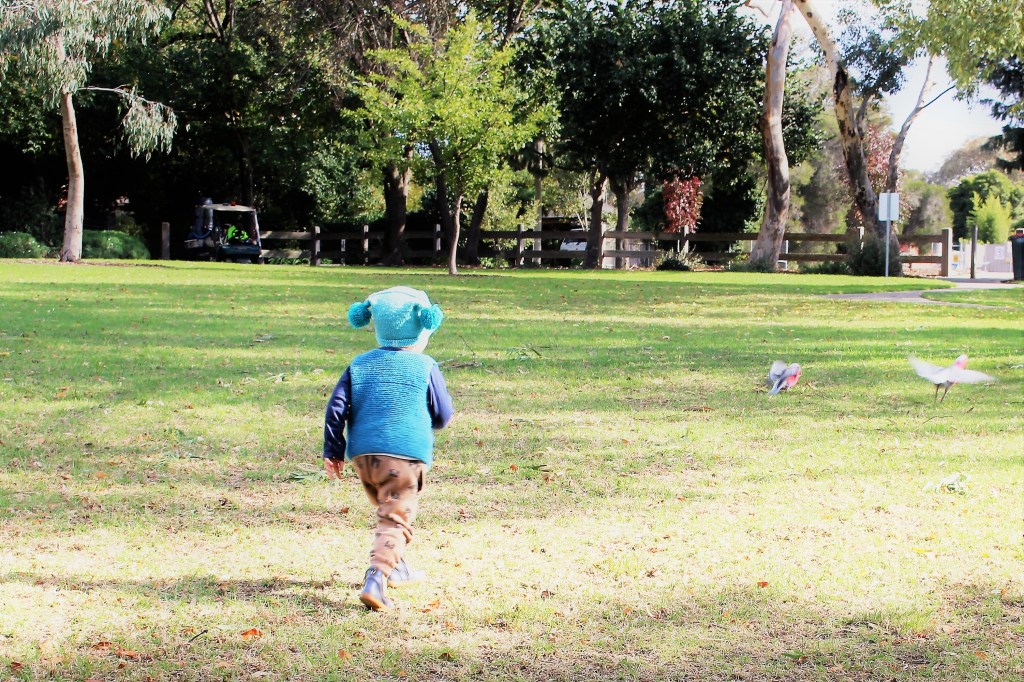
Each of the 12 senses can be present in the body in an over-activated or under-activated state. For example, a child who often falls over may have an under-activated sense of balance. This could be improved by offering more opportunities to work the sense of balance; swinging on monkey bars or swings, spinning in circles, balancing on small surfaces, balancing on one leg or riding a bike can all help the sense of balance.
Providing children with a nourishing, developmentally appropriate learning environment can help to balance the senses. Next blog post will look more into how we can balance our young child’s sensory needs.
Have you noticed any of these senses developing in your child?
Further reading:
The 12 Human Senses GA 169 – Rudolf Steiner
Man’s Twelve Senses in Their Relation to Imagination, Inspiration, and Intuition – Rudolf Steiner


 The Steiner Connection
3 responses to “The 12 Senses”
[…] Left brain hemisphere is limited to language and symbols heavily focussed on only our five animal senses. Right brain hemisphere accesses all of Rudolf Steiner’s 12 Senses – https://thesteinerconnection.com/2022/07/21/the-12-senses/ […]
LikeLike
The senses can be divided into three broad categories tied to learning:
– Sensing our own body – Balance, proprioception, life, touch.
– Sensing the world – Taste, smell, warmth, sight.
– Higher senses, learning about others – hearing, thought, speech, ego (of the other).
Two small additions, sense of self movement is proprioception. Our sense of the limb and body placement in space.
Sense of ego refers to the ego of the other, not our own.
LikeLike
It is important to consider that senses needs must have an organ of perception. Without this critical understanding, a lack of precision in grasping just what a sense is will cloud the experience of being human. It is self-evident that the eyes, ears, nose, & mouth each have their corresponding sense experience. The sense of “touch” has long been a basket of experiences wherein a range of sensations are placed. For example, the vestibular system of the inner ear, the proprioceptive system that exists throughout the skeletal-muscular system, and the interioceptive system which allows the human to experience bodily needs such as hunger, internal pain, or other bodily functions can be generally regarded as perception of touch meaning an internal receptor within the body arises in the consciousness of the human being. When a young child spins around into dizziness, the vestibular system as been overwhelmed with input. However, each of these sense experiences cannot easily be compartmentalized into a single sense organ. The fact that the so called sense of balance is an amalgam of vestibular, proprioceptive, & visual perception makes it clear why the 12 senses are not widely understood. Carrying this idea of the amalgamation of the senses further is the only way to cogently grasp those senses which do not yet have an identified organ of perception such as warmth, ego, thought, & word. Certain areas of the brain have been identified as receptors of words but it would be a stretch to identify Broca or Wernike areas as sense organs. So, whenever the word sense is used in a sentence or proclamation, it is critical to ask “What is the organ of perception of that sense?” Is it an amalgamation of sensory experiences or an organ of perception that is still nascent or undeveloped.
LikeLike