
We all know what it’s like to feel out of balance.
We might snap more quickly than usual, a 10 minute task can take an hour or we may walk into a room and look around wondering what we came for…
No one enjoys feeling out of balance – our children included. What if we could work with our child’s sensory needs to help them feel more in balance?

Sensory development from 0 to 7
Steiner explained that each of the 12 senses and it’s development is associated with a particular life phase. The 4 senses of focus during early childhood are:
- Touch
- Life
- Self-Movement
- Balance
Harmonising these senses can assist our child with their developmental and sensory needs.
Let’s look at each one in more detail.
Touch
The sense of touch relates to where the boundary of our body ends and the world begins.
The over-active sense of touch
If the sense of touch is present in a hyper-sensitive state, then our child will feel more sensitive to what comes into contact with their body. This is often expressed by children as complaining that their socks are too tight or their jumper is itchy.
The under-active sense of touch
If the sense of touch is present in a hypo-sensitive state, the child may have a need to push others, or objects, so that they can experience the boundary. They may have limited understanding of personal space and have trouble gauging space and distance.

How to harmonise the sensory need of touch
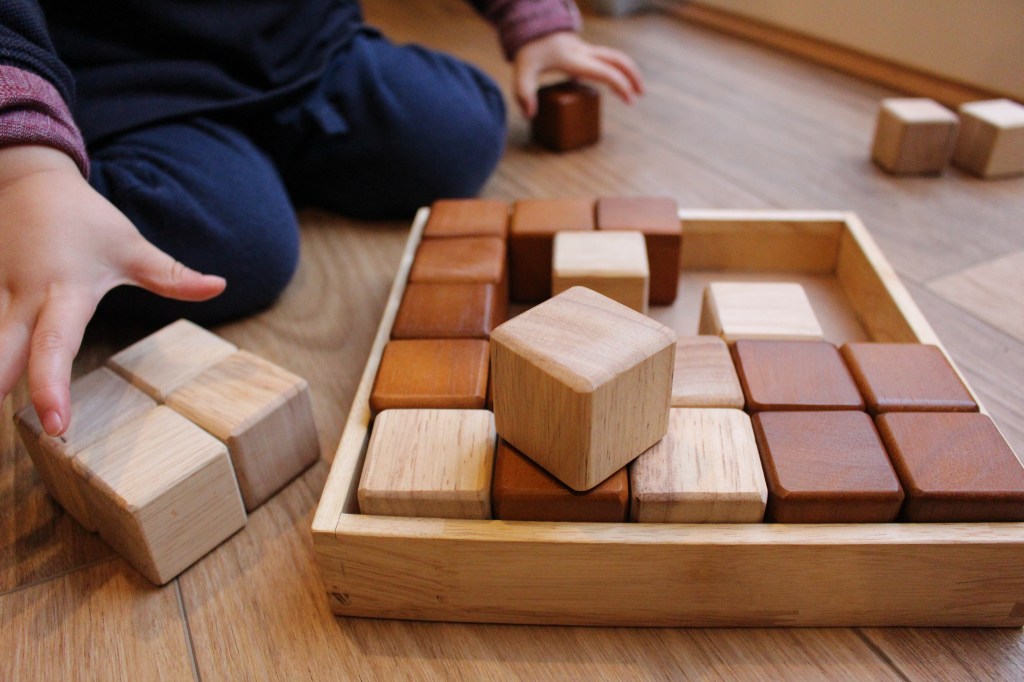
Providing an environment which includes toys and resources made of natural materials can help to nourish the sense of touch. Resources created from wood, wool, silk and cotton all contain an element of life from the products which they came. Offering a variety of these natural materials gives children a rich environment for their sense of touch.
Spending time outdoors can also provide opportunities to nourish this sense. Outside, children will naturally come into contact with a wide range of textures, weights and surfaces. By allowing children free time to explore in nature we can offer them a rich opportunity to develop their sense of touch.
Setting firm and loving physical boundaries can also help children to navigate their sense of touch. Particularly with children who have a low physical self-awareness, you may find that they need more assistance in learning where the boundary lies between their body and the world. These boundaries can relate to the home environment, their own body and others’ bodies, or the boundaries created by the daily rhythm.
Another way to develop the sense of touch is through fingerplay and hand games. The games need not be complicated, classic nursery rhymes such as Incy Wincy Spider and Open, Shut Them all engage the sense of touch. More Waldorf inspired games can be found in The Waldorf Games Handbook and Seven Times The Sun.
Other activities to engage the sense of touch include; handwork, such as finger knitting and pom-pom making, drawing and painting, modelling with beeswax or clay, and baking, especially bread or biscuits where little hands can get involved.
Life
The life sense is important in alerting us when we are ill or in pain. It also arises in children when they are tired, hungry, thirsty or need to go to the toilet.
The over-active life sense
An over-active life sense may present as a child who has a low pain threshold or who becomes deeply unsettled by a change in rhythm.
The under-active life sense
The under-active life sense may present as a child who has little awareness of when something is wrong in their body. They may not realise that they are injured or take a long time to complain about physical changes in the body.

How to harmonise the life sense
A strong daily and weekly rhythm can help children to balance their life sense. Knowing that everything in the home has a place is reassuring for children. Packing toys away, putting shoes in pairs and unpacking the dishwasher are all activities which can balance this sense.
Having said that, the child with an over-active life sense who struggles with change, may benefit from experiencing a disruption and healing from it. If they are able to work through a change in routine and voice their emotional concerns to a supportive adult, it can help them to balance this sense.
Children with an under-active life sense may need assistance when they are injured or unwell. They may need attention to be drawn to the injury and to be shown how to care for themselves.
Experiencing the changes in nature, seeing tasks through to completion and experiencing rhythmic movement all help to develop this sense. Listening to stories where the characters face and overcome adversity can also assist the life sense.

Self-Movement
The sense of self-movement involves our experience of moving through space.
The over-active sense of movement
The hyper-sensitive state of movement may present as a child who becomes overwhelmed by movement. They are hyper-aware of feeling physical changes in their body and this can prevent them from moving. This child may anticipate the catching of a ball.
The under-active sense of movement
The hypo-sensitive state of movement may be seen in children who have a low self-awareness and are often clumsy. They may struggle with skipping.
How to harmonise the sensory needs of self-movement
This sense can be developed through gross motor skill activities. Building, climbing, gardening and circles games which involve jumping, skipping and running, can all balance the sense of movement.
Showing a child how to do something, such as digging in the garden, is more effective than explaining. Demonstrating these activities will give your child the best opportunity to learn through imitation and develop these skills.
Storytelling offers an opportunity to experience what it feels like when the body is not moving. Providing an example of what it looks like when the body is still and calm while telling a story, will give your child an opportunity to develop their self-awareness.

Balance
The sense of balance is related to how we experience the external world.
The over-active sense of balance
The over-active sense of balance may appear in children who experience motion sickness. They may be sensitive to spinning and avoid risky activities.
The under-active sense of balance
The under-active sense of balance may present as a child who takes more risks and is less aware of changes in their equilibrium.
How to harmonise the sensory needs of balance
This sense is engaged by experiencing activities that require the child to return to upright. Walking on uneven ground, balancing on one leg, climbing on structures and riding a bike can all develop the sense of balance. Regularly incorporating these activities into your child’s day can help to equalize this sense.

The first seven years is a time of such growth and change. Being aware of our children’s sensory needs can assist us in nourishing them to the best of our abilities.
Have you witnessed the development of any of these senses in your child?
Further reading:
https://www.seasalthomeopathy.com.au – Lisa Romero
Man’s Twelve Senses in Their Relation to Imagination, Inspiration, and Intuition – Rudolf Steiner


 The Steiner Connection